The Real Reason Nothing's Worked For Your Dog's Reactivity — And The Fix Most Owners Are Never Told
If you've spent thousands on trainers and your dog still explodes at every trigger, read this short article before one bad walk changes their future forever.

Hi, my name is Dr. Rodriguez, and for the last 9 years I've worked as a vet at Another Chance K9 Rescue in Austin.
And after seeing over 830 of the most reactive dogs you'd ever meet come through our doors, I discovered something crucial you need to know:
Reactivity isn't because of their past or how they're wired.
There's something happening inside every reactive dog right now that no trainer, vet, or behaviourist is trained to look for. And it's the reason training has felt like two steps forward, one step back.
I've seen what happens when owners don't know about this and it breaks my heart.

Their world shrinks a little more every month. Walks move to 5am. The blinds go shut and stay shut. They cancel on friends to watch their dog… and then the invitations just stop coming.
And they'll tell me through tears that some mornings, standing in the dark scanning for triggers, a quiet voice says “this isn't what I signed up for” and they hate themselves for even thinking it.
Because they love this dog more than anything, so they don't give up.
But the hidden thing causing all of this keeps pushing their pup closer to the edge every day they don't know about it.
Until one morning all it takes is an off-leash dog and the words 'they're friendly!' - and suddenly they're trying to pull their dog off wondering if this was the moment that decides everything.
But if you're reading this right now with your pup next to you, you can still change that story.
Because three years ago, I noticed something happening inside our kennels that changed how we deal with reactivity.
It finally explained why our dogs would remember training in the sessions but not on walks, and why medication never made a real difference.
The Real Reason They're Reactive
We have a separate holding area at our shelter where new dogs spend their first week. No triggers, just quiet.
I noticed dogs that arrived lunging and growling would suddenly soften after five days. They became entirely different dogs.
But the second we walked them into our main kennel, it was like that version of them just died.
That's when I found a PubMed study on cortisol in dogs that changed everything.
Every time a reactive dog sees a trigger, their stress hormone cortisol spikes. And in dogs, it takes days to come back down, not hours.

But it never gets the chance to drop, because the next trigger is always just a few hours away.
So their cortisol just keeps climbing higher and higher.
And a body flooded with cortisol physically cannot drop into deep sleep.
Dogs need up to 16 hours of sleep a day to regulate their emotions. Most reactive dogs are getting six or seven, almost none of it deep.
That's why whenever they're 'asleep' and a car door slams or you put your mug down too loud, one eye slides open.
And that's why training works for a few days then falls apart, their brain is too exhausted to hold onto it.
But most owners are never told about this, and neither were we. Because every professional is trained to treat the behaviour, not the thing that's silently causing it underneath.
Once I understood this, I knew I had to find a way to lower cortisol that didn't rely on a quiet holding room, because we had 57 reactive dogs, not 3.
So We Started Testing

The first thing we tried was exercise. If cortisol is a stress hormone, burning off the stress should lower it. But it actually made them worse. Exercise doesn't clear cortisol, it spikes it.
So for the next seven months, me and the other shelter vets worked every night after our shifts, testing different combinations of natural ingredients and dosages trying to help the 57 dogs that everyone else had given up on.
Then on a random Tuesday morning in May I walked into our main kennel and saw something I hadn't seen once in nine years.
My co-workers had let them all out into the main room together, and the most reactive dogs I've ever met were sat playing with each other. For most of them, they'd just made their first friend ever.
After 43 failed formulations we had finally found one that worked.
The secret wasn't the ingredients. It was the way they work together overnight.

We started giving them to every reactive dog that came through our doors. Within weeks, adopters were asking if they could buy them to keep the dog they'd fallen in love with at the kennel.
Then other shelters reached out. Then vets. It got to a point where we couldn't keep making them at our shelter anymore.
So we partnered with a team of veterinary formulators at a lab called BioPaw and turned it into something that could help reactive dog owners everywhere.
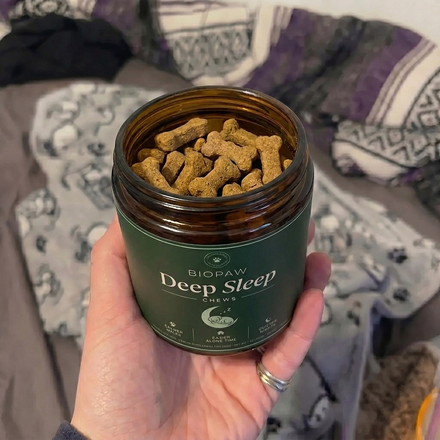
Introducing BioPaw Deep Sleep Chews
All you do is give your pup two chews before bed each night.
Even the fussiest eaters at the shelter, dogs who've eaten around supplements wedged in cheese before, eat them straight from our hands and want more.
Here's what you can expect:
But don't just take my word for it…
At the time of writing this, over 47,000 reactive dog owners are using the chews to finally enjoy their pup the way they imagined when they first brought them home.




This could be you a few weeks from now.
Just imagine going places with your dog and being proud of them:
Or you can wait and hope the training starts to stick.
But the longer their brain goes without the rest it needs, the closer they get to doing something they can't control. And it only ever takes a few seconds.
I've worked with too many amazing owners to stay quiet about this because every single one of them thought it would never happen to their dog. Until it did, and they had to live with that forever. That's why I'm writing this.
How can you get your hands on some?

Well this is the part that frustrates me…
Shelters across the country are now buying them by the hundreds, which is amazing, but it means we sell out constantly.
And because every batch has to meet the same vet-grade quality standards we set when it was just us and our 57 dogs, restocks take around 1–2 months.
That part honestly breaks my heart because every night a reactive dog goes without proper sleep matters, and I don't want any dog parent to have to wait.
But if you're reading this, it means we still have chews in stock right now. Otherwise I would have taken this page down.
So I know what you're probably thinking, how much does it cost?
Well I've got good news.
I priced it at half of what I was told to…

When we first released BioPaw to the public, our marketing team told us to charge $90 for one month.
And honestly it made sense from a business perspective.
But I'm not a marketer. I'm a shelter vet.
And I didn't spend seven months of late nights developing these to make them unaffordable for the people who need them most.
So I said they had to at least cut the price in half.
So now a month's supply is just $44.99.
But I still wasn't happy.
Our results showed the biggest changes happen within the first three months of consistent use, that's when cortisol finally drops back to baseline and the brain has had enough rest for them to feel like themselves again.
So after a long back and forth, I got them to agree to a special offer for anyone reading this:
Buy 2 jars, get 1 FREE. That's a full 3-month supply for just $88.99.

That works out to only $0.99 a day…
And that sounds even better when you compare it to:
But that's still not the best part…
To celebrate the release of my new Reactivity Course that's based on everything I've learned from working with over 830 reactive dogs at our shelter, I'm including it free with the limited-time 3-month offer.
You have 60 days to try it completely risk free

So you can see how well they work for your dog with complete peace of mind.
If you start to see the dog you always knew was in there, you keep using them.
But if for ANY reason you're not happy, just contact our team at support@trybiopaw.com and you'll get your money back that same day, no questions asked.
Our return rate is less than 0.1% because the chews genuinely work, but the guarantee is there so you only pay if you and your pup love the results.
So here's what to do next

So here's what to do next
You have two choices right now:
You can close this page and keep doing what you're doing. The 5am walks. The shut blinds. The constant scanning. And hope that training finally sticks, even though now you know why it hasn't.
But every night without deep sleep, their brain becomes a little more exhausted. And an exhausted brain doesn't give warnings before it snaps.
Or you can give them the rest they've so badly needed. Watch the difference on the walks. Open the blinds. Introduce them to your family without watching them like a micromanaging mom.
I've seen these work for dogs with severe bite histories, dogs that came into our shelter so reactive that no one else would take them. Trust me, they'll work for yours.
Your dog can't tell you they need this. They just know something is wrong and they don't know how to fix it.
But now you do.
They're not a bad dog. They're exhausted.
And tonight, for the first time, you can actually do something about it.
A few weeks from now you'll thank yourself. But more importantly so will your pup.